Saturday, May 30, 2009
All this work...and no play?
Wednesday, May 20, 2009
The Problem Tree
In this part of the training course we are studying Analysis of Reality. Again translation does not do me much justice, so while I search for a better word, I could sum it up as all the things that we use to analyze a particular place where we want to work. In order to begin any type of social work, of course it is necessary to do a further investigation into the area where you are going to work. That would be the general idea for this module.
During the instruction of Analysis of Reality the students learned...
0. How to conduct an observation of a particular area/place of study.
0. How to design a questionnaire.
0. Proper techniques when asking people to fill out a questionnaire.
0. Different types of interviews.
0. Research of government sources and resource materials.
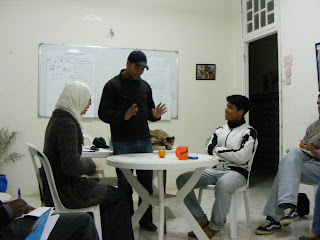
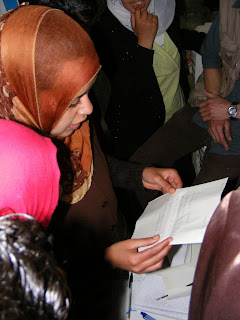
The students themselves created a questionnaire and were responsible with interviewing people on the street at random about education here in Morocco. This was done to help us prepare for what was the biggest part of this part of the course, The Problem Tree. As for anyone working in a social field, we are always confronted with various problems in our society. Now in order to guide these into a project we have to a good understanding of the chain of cause and effect of the various problems that are present in the area we want to work in. For this we use the problem tree:
To help with the instruction of the Problem Tree we relied on the assistance of a team of specialists from Spain.
Here they are:
Tuesday, May 19, 2009
The Bridge
Today’s class has served as a summary of all the material that we have been working on during the last month. Over this period we have been focusing on such things like:
- the responsibility of the monitor as a transmitter of knowledge, attitudes, and abilities,
- the monitor and the group
- how to perform an evaluation
- the difference in the capabilities of the individual versus the group
- communication,
- problem solving,
- team work,
- the role of the individual in society,
- and other basic concepts of sociocultural animation
As a final activity to recap all the learned during the last three weeks the instructor created an activity ,The Bridge, as a way to regroup all the material in a way that is entertaining, creative, and productive.
The Bridge works like this:
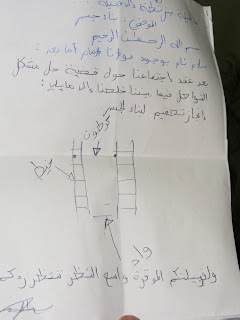
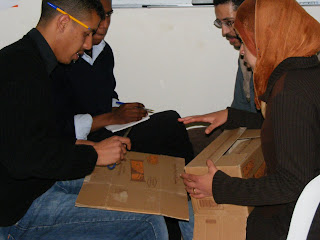
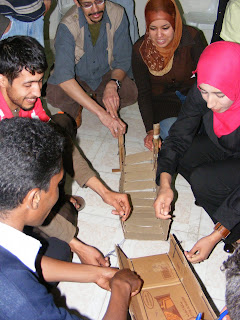
There are two villages. These two villages are separated by a river. This river has made communication between the two villages difficult, practically impossible. The students are divided into the two villages. Each village is given a carton box, scissors and two meters of string. The objective of the activity is to construct with the given materials a bridge that crosses the river. The two villages, of course, cannot communicate drectly with each other, each village is permitted to send two letters to the other village and permitted two meetings between the designated representatives of the two villages.
The activity demands concentration, dialogue between the group, team work, division of responsibilities, oral and written communication, not to mention some creativity. It was a fantastic way to bring to an end the first two parts of the course. In the end, both groups used the concepts learned in the first three weeks of class to solve the task and successfully completed the bridge although it wasn’t perfect it was strong enough to pass the test.
Village Number One
Wednesday, April 29, 2009
Constructing on top of the ancient ruins of yesterday towards the progress and possibilities of tomorrow
.....Last weekend, we decided to take a trip together with the students to “discover” the ancient Phoenician and Roman city of Lixus that lies on the outskirts of the city of Larache. I say “discover” because for many of the students, even though they have lived here all their lives, have never had a chance to visit this city, thought to be the oldest city in Morocco. After the demanding first three weeks of the course, us teachers that it would be good to take a day off and spend some times together outside of the classroom.
The program:
Tour and visit of the ruins of Lixus.
Tuesday, April 14, 2009
VI Spring Intercultural Encounter Hispano-Moroccan In Larache Morocco
The Luckiest Guy In The World
That’s the way I felt walking home under a gentle blue sky, knowing that I do THIS for my job, and for the first time in my life I thought that its truly possible that nobody else has it as good as I do.
Saturday night we wrapped up the sixth version of Semana Santa, and looking back on it now, I cant quite get my grip around the words worthy of expressing what every person, all 33 of us that were in that room, felt last night. It was a moving experience, something that touched all of our souls, brought joy to our bodies as well as our minds, and we were all there united by our love for this life, love for human beings, and love of sociocultural animation.
The program…
Friday
Introduction and Commencement of the VI Spanish-Moroccan Intercultural Encounter.
Workshop and presentation by the students of the class Technician Socio Cultural of Larache- The History of Larache
Workshops presented by members of the class of Socio Cultural Animation of the Superior Institute of the Macarena, Seville-Spain
a) How to Plan an Activity
1) Ten Easy Steps To Plan a Carnival
b) Methods for the creation of dynamics through the use of ones creativity
1) Through art…come up with an idea for an activity in the field of sociocultural animation
c) Conflict Resolution
Saturday
a) Morning workshop: Popular games of Spain and Morocco.
Alternating between games and dynamics that are well known in each country.
b) Dance Workshop
Exposition of Spanish dance. Flamenco and Sevillanas.
c) Group Lunch
d) Juggling Workshop
e) Cooking Workshop
-How to make Andalusian food- Salmorejo
f) Costume and face painting Workshop
g) Carnival-Fiesta
h) Closure of the VI Semana Santa
Its moments like these that give me hope. I know what everyone is saying, I know that the prospects are dim. I have even heard the trees themselves say that there way of life is dying and that mother earth is suffering badly. The elders say that every generation is worse than the last, the teachers say that the students don’t want to study anymore like they used to, and young people themselves say that there is no hope and no future for them in today’s world. Yet, as god as my witness, there is something out there makes me believe and there is something special that I see in the young people that I work with. I know in the deep of my heart that there is still a chance out there, and as of yet, I have not lost hope neither in the goodness of the human spirit, and its infinite possibility for regrowth, forgiveness, and new beginnings.
Now it’s not easy to transmit this hope that I possess but I know I am not only the one. In fact I hope that my own hope is contagious to others out there. And just in case anyone is not convinced…take a look at some of the photos taken during the activities this weekend.
Peace love and truth everybody!!!
Thanks!!!
Thursday, April 9, 2009
Inauguration of the Third Course in Socio Cultural Animation For the Associations of Larache
When I was first hired for the job the concept by name was completely new to me. But, never being one afraid of trying new things, this exciting new challenge offered by this innovative style of education immediately attracted me to the job position. Socio-cultural animation is relatively unknown back in the United States and I am happy to do my best to give life to the term for the people back home. Socio-cultural animation encompasses so many of the things that I believe in and build my life around and its exciting for me to have the chance to once again bring the concept to a new group of young people here through the work of this NGO.
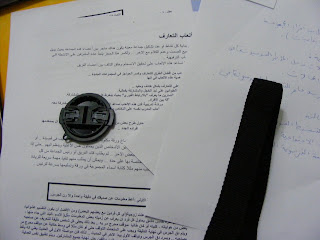
What is Social Cultural Animation?
It’s to give life, to create feeling, to move, to motivate, to energize, to accompany, to communicate, to help grow.
If I could borrow from the wonderful prepared material by our volunteers in Spain to help explain the term:
“It could be described as:
• A process directed towards the organization of people to carry out projects and initiatives from a cultural viewpoint towards a goal of social development or progress. The four pillars of the sociocultural animation are: the culture, the organization of individuals, projects and initatives, and social development.
• A series of actions which offer the individual the possibility to transform themselves into an agent of their own personal development and that of their community, which generate processes of participation, respond to real needs taking into account the centers of interest of the persons involved and that is based upon a pedagogy that is active and dynamic.
• A privileged instrument to make possible a situation of cultural democracy
• A social technology, based in a participative form of pedagogy, which acts in different aspects of the quality of life of a person, through the participation of the people in their own social development.”
In the course we teach that socio-cultural animation basically states that each person is responsible for his own destiny, that we create the society and the area that we live in, for we are not just simple observers but actors in the dynamic between people and the institutions and mechanisms that affect our lives.
One former student described it as: “If we put together all of the areas of our life that are grouped into socio-cultural animation we discover that it is a factor in about 95% of our daily life. Taking this course is something that can actually change your life.”
Yet, here in the less developed world, Africa, and Morocco in particular it’s can be challenging to get young people to believe in such an idea when they are taught in society a negative and powerless image of themselves and the world around them. The idea is continuously reinforced that poor is poor and brown is black and some people are on top and the majority on the bottom and there is nothing you can do about it but to put yourself in line and become part of the system. So, there is a formative educative process that is needed. And even then its for still not easy to get someone to believe when society and culture have trained them not to.
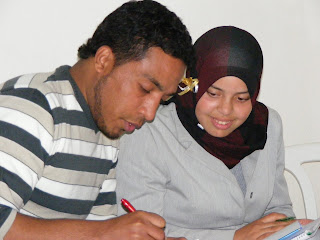
It’s a group of 13 students, (we are hoping that it eventually increases to 20) of seven girls and six guys. Among them there are high school students, a young leader of the first youth network in Larache, young people that work in the service industry, carpenters, builders, a bright, creative young lady with a degree in sociology, volunteers from associations that work with children, professors of “free” education and young people that have finished high school and are now pursuing additional training in various fields. They come from diverse associations and it’s a group that is intelligent, motivated, and beautiful…very beautiful.
And a special thanks goes out to Mark Smith for the helpful description of socio-cultural animation. Smith, Mark K. (1999, 2009) 'Animateurs, animation and fostering learning and change', the encyclopedia of informal education. Here is his work which does a great job of explaining the concept of socio-cultural animation
[www.infed.org/animate/b-animat.htm] If anybody would like to know more about the field of sociocultural animation, check out the website above.
Saturday, April 4, 2009
Larache and its Port
In order to understand Larache you have to know that it all begins with the port. It’s a place where a boy of 15, who never cared much for studying, can find work and dreaming of squid, shrimp, and lobster find his way to what seems like “easy money”.
The fish industry here employs about 5000 people, from the one who drives the motorcycle that moves the fish around, to the ice seller, to the one that collects enough scraps off the boat docks until he can sell a kilo the hungry passerby.
There used to be five factories here. They have all since closed down. The port is the last remaining gold rush here in the city. Anyone can come down with twenty bucks, buy kilos of fish, and make enough to sit in his favorite café, drink coffee and pass the afternoon smoking hashish, and doing the best a poor boy can do to look nice for the the ever so materialistic ladies on parade. Waking up the next day its back to the port to do it all again the next day.
For those of a more brave nature, they can take to the sea. One week of work can take in 600 dirhams depending on the quantity and the quality of the fish they bring in. The life of the fisherman is not an easy one and it is what gives Larache its rough flavor.
Now with few work opportunities the city is completely dependent on the fishing industry and money sent from relatives abroad to survive. For this the dream of joining those on the outside everyday grows stronger and stronger. Its rare that a young person here would tell you that he wouldnt leave behind everything just for one shot to make it to Europe.
So... the way to salvation always leads perilously through the sea.
You can tighten your belt and head out for a hard days work on a fishing boat
All roads lead out to the sea
The special thing about Larache is the fact that its a place that has a charm that is a bit rough around the edges. Here, just outside of the tourists zone is where you will find both the undiscovered charm of a place out of the reach of tourist buses and big hotels but at the same time you will find yourself also confronted with the harsh reality of a Morocco that makes no effort to coddle you and pull in your tourist dollars. In fact life can be quite hopeless for many of the young people here as many of them cant seem to find their way out of a maze of alcohol, drug abuse, and the street life. Indeed, any visitor can easily see that things in Larache are in stark contrast to the way the country is presented to the ten million visitors that the Moroccan government hopes to welcome here by the year 2010.
Sure a donkey or a little girl fetching water are picturesque for those coming from outside Morocco. But for a grown man with five children earning 5 dollars a day, it’s just a cold, harsh reminder of the way things are.
During my entire first year here in Larache I was amazed at the poor condition and the at times scandalous language and behavior of the people when compared with other cities that I know here. I couldn’t understand the depilated and rough appearance of the city and its people after knowing well the luxury and pictureistic beauty of the well known tourist spots. But the day I returned to the city, walking back from the port, it finally all clicked. I realized that part of the beauty of this place is that fact that it is in a sense REAL. For the first time, looking through my new perspective, it all didn’t look so bad. The faces were recognizable, the language only half as vulgar as the port, and the city while it may not smell or look so pleasant for the new visitor, after leaving the world of the port and a hard days work behind you, my goodness … It all seemed very relaxing and pleasant indeed.