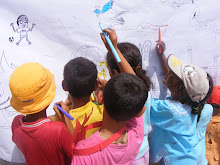
After completing the course in 2006 and 2008, I am very proud to be present to you the opening of the course, now in its third year, 2009. This past Wednesday was the inauguration of the Third Course of Social Cultural Animation presented by
Tareas Solidarias Caravana Por La
Paz in
Larache.
When I was first hired for the job the concept by name was completely new to me. But, never being one afraid of trying new things, this exciting new challenge offered by this innovative style of education immediately attracted me to the job position.
Socio-cultural animation is relatively unknown back in the United States and I am happy to do my best to give life to the term for the people back home.
Socio-cultural animation encompasses so many of the things that I believe in and build my life around and its exciting for me to have the chance to once again bring the concept to a new group of young people here through the work of this
NGO.
So for those who are not familiar with animacion socio cultural...
 What is Social Cultural Animation?
Okay the first part, socio-cultural, that is easy enough, it’s the word animation that is a bit difficult to grasp. In English animation doesn’t mean much. Personally, it makes me think of cartoons, the process of creating motion and stories through images. But in other languages, the word animation means to breathe life into something, to give it energy to it, to make it move, to dynamize, to create action, thought, and consciousness in the object that was once still. To bring the idea into a closer context we can find similarities in English by thinking of animation as a combination of three similar concepts: community education, social pedagogy and informal education, yet the three together still don’t do the concept justice.
It’s to give life, to create feeling, to move, to motivate, to energize, to accompany, to communicate, to help grow.
If I could borrow from the wonderful prepared material by our volunteers in Spain to help explain the term:
“It could be described as:
• A process directed towards the organization of people to carry out projects and initiatives from a cultural viewpoint towards a goal of social development or progress. The four pillars of the sociocultural animation are: the culture, the organization of individuals, projects and initatives, and social development.
• A series of actions which offer the individual the possibility to transform themselves into an agent of their own personal development and that of their community, which generate processes of participation, respond to real needs taking into account the centers of interest of the persons involved and that is based upon a pedagogy that is active and dynamic.
• A privileged instrument to make possible a situation of cultural democracy
• A social technology, based in a participative form of pedagogy, which acts in different aspects of the quality of life of a person, through the participation of the people in their own social development.”
In the course we teach that socio-cultural animation basically states that each person is responsible for his own destiny, that we create the society and the area that we live in, for we are not just simple observers but actors in the dynamic between people and the institutions and mechanisms that affect our lives.
One former student described it as: “If we put together all of the areas of our life that are grouped into socio-cultural animation we discover that it is a factor in about 95% of our daily life. Taking this course is something that can actually change your life.”
Yet, here in the less developed world, Africa, and Morocco in particular it’s can be challenging to get young people to believe in such an idea when they are taught in society a negative and powerless image of themselves and the world around them. The idea is continuously reinforced that poor is poor and brown is black and some people are on top and the majority on the bottom and there is nothing you can do about it but to put yourself in line and become part of the system. So, there is a formative educative process that is needed. And even then its for still not easy to get someone to believe when society and culture have trained them not to.
But enough talking for now … come and get to know the students of this year:
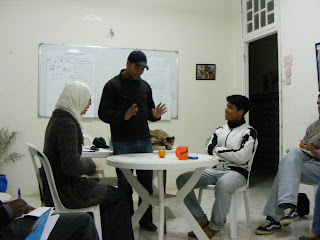
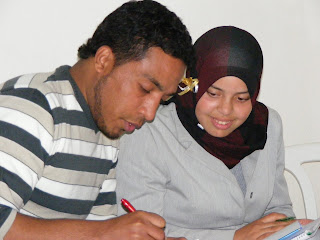
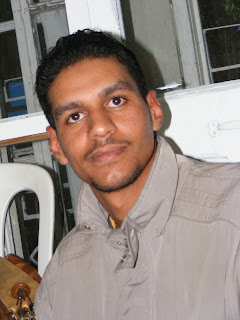
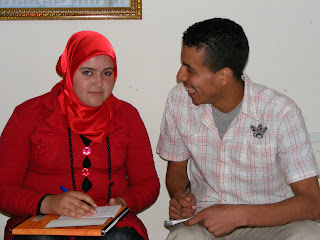
It’s a group of 13 students, (we are hoping that it eventually increases to 20) of seven girls and six guys. Among them there are high school students, a young leader of the first youth network in
Larache, young people that work in the service industry, carpenters, builders, a bright, creative young lady with a degree in sociology, volunteers from associations that work with children, professors of “free” education and young people that have finished high school and are now
pursuing additional training in various fields. They come from diverse associations and it’s a group that is intelligent, motivated, and beautiful…very beautiful.

Thanks!!!
And a special thanks goes out to Mark Smith for the helpful description of socio-cultural animation. Smith, Mark K. (1999, 2009) 'Animateurs, animation and fostering learning and change', the encyclopedia of informal education. Here is his work which does a great job of explaining the concept of socio-cultural animation
[www.infed.org/animate/b-animat.htm] If anybody would like to know more about the field of sociocultural animation, check out the website above.


 Thanks for all the help guys!!! You did a great job!